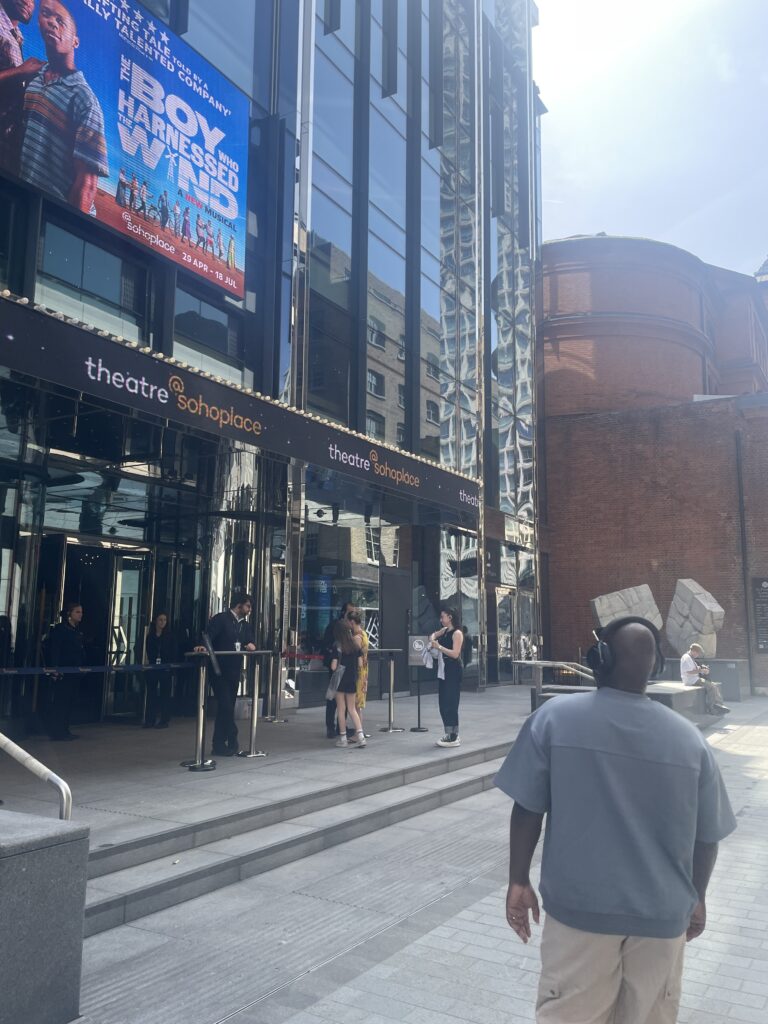
Reflections from The Boy Who Harnessed the Wind
No man is an island. And few stories remind you of that quite like The Boy Who Harnessed the Wind.
I watched the play at Soho Place – London’s new West End theatre – and it was honestly beyond my expectations. It was my first time at that venue, and from the beautiful space itself to bumping into familiar faces, to the performances, the singing, the dancing, and the instrumentals, it just really exuded excellence. Everyone I spoke to felt the same. It’s absolutely worth it, and I would recommend it without hesitation.
For those who do not know the story, it is set in Malawi and follows William, a young boy with a fierce drive to learn and to solve real problems facing his community. What tried to hold him back was not ability. It was money. His father struggled to pay school fees, and at one point William was turned away from class. A member of staff found a way to support him anyway, including giving him a book. William took that and ran with it. He read about energy, and rather than stopping at understanding it on a page, he took it further. He wanted to build a windmill to generate electricity for his community, to bring light, water and the ability to grow crops. His mother believed in him. Friends eventually came alongside him. His father eventually came on board too and, in one of the most moving moments of the story, gave up his own bicycle for the greater good of the community. When the community came together, pooling different resources and skills, the windmill worked. The community had light. Water. Crops.
As an experienced science educator and someone who supports young people in mainstream and alternative provision, that story landed deeply. William did not have a lab. He did not have resources. But he had curiosity, a vision, and eventually a village. He took his learning into his own hands and did science practically, using what was around him.
This is exactly what I see in the young people I work with. I have seen teens who struggle to engage with heavily text-based content come alive during a practical. Young people who can link energy concepts to wanting to take apart their phone and understand how it works. Students who thought science was not for them are correctly identifying exothermic reactions because we found a different way in. With patience, gamification, small chunks, variety and the right environment, something shifts. Creating that psychological safety for a young person who has decided something is too hard for them is one of the most important parts of the work. Listening to what works for them matters too. We do not have to have all the answers. What we have to do is keep the door open and champion their questions.
STEM is not reserved for those who get grade 9 or A-grades. A young person does not need to want to be a doctor or an engineer to explore, make things and innovate. I believe we are all created by a Creator, and we can create. It looks different for each person, but the potential is there.
Just imagine what our young people could build if they were given the chance, the encouragement and the openness to try. William showed us. The windmill was real.
That same evening I bumped into someone at the live play who I had only previously met at community events. A real conversation, a genuine connection. That kind of organic moment does not happen if you stay in the same four walls. Community shows up in the most unexpected places, and when it does, it is worth paying attention to.
Curiosity and confidence are a currency. See its value and work on developing it, whatever that looks like for you.
Discover more from Thrive Beyond Labels
Subscribe to get the latest posts sent to your email.