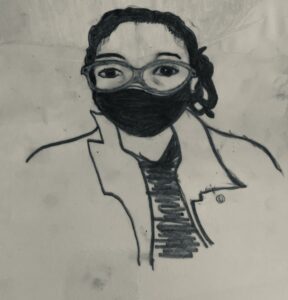
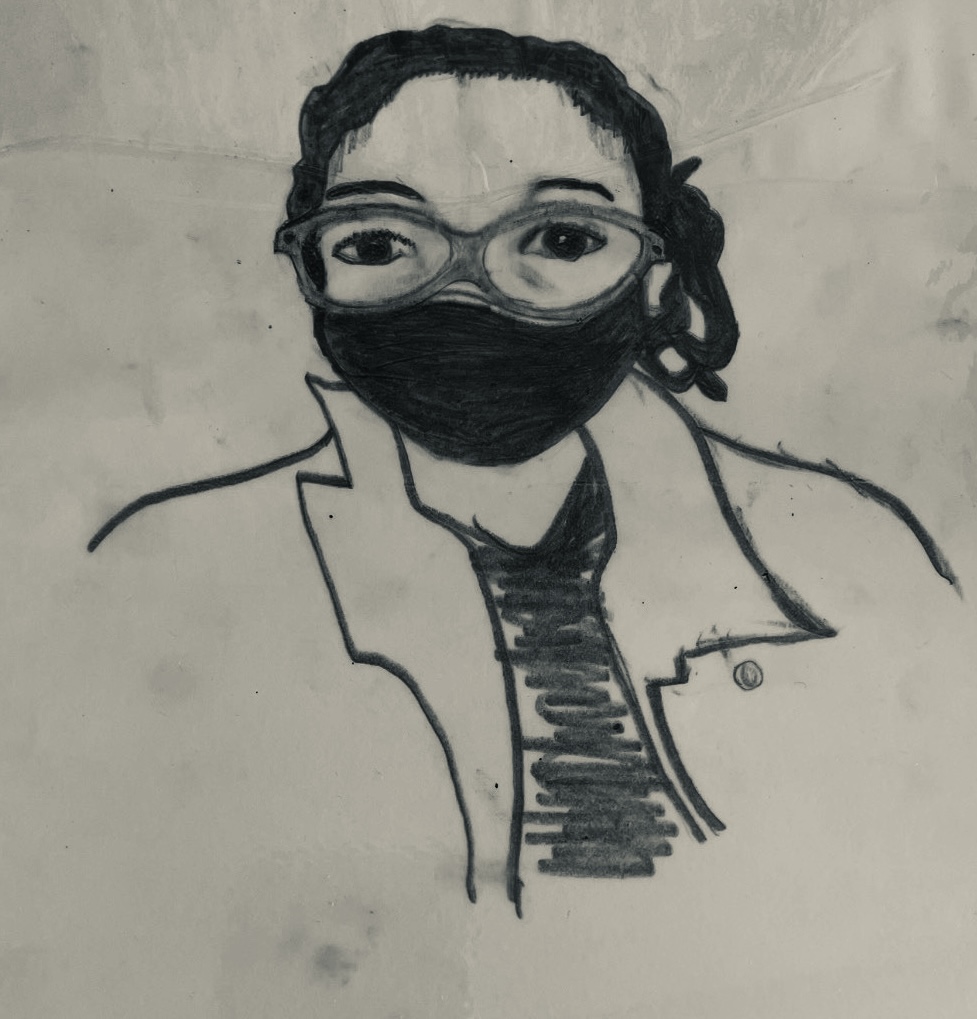
A student once drew me from real life, back when masks were something everyone wore. The mask in that drawing was real. It has come to mean something else to me since, a picture of a pattern I have lived myself and now watch for constantly in the young people and women I work with, especially those from Global Majority cultures.
There is a particular weight worth understanding for anyone raising, teaching, or leading young women, the pressure placed on them early not to disappoint the village. I felt it long before I could name it. Keep pressing. Stay cheerful. Carry on. Struggle gets read as weakness, so the instinct becomes to hide it rather than name it. A young woman who seems unusually composed is often worth a second look rather than automatic reassurance.
I remember this lesson clearly from my own school years. If a learner answered a question wrong, there was laughter, or a smirk, and that learner would quietly get filed away as unintelligent, or just not good at the subject. Nobody stopped to remember that everyone has their own strengths, or that a mistake was never proof of a lack of intelligence. Classrooms and households alike would do well to name this out loud, because young people absorb the lesson whether or not anyone says it directly.
Here is the teaching point I keep coming back to when I work with young people and their families. Work ethic matters, but it is the way someone works that makes the difference. I pushed myself harder than necessary as a student, chasing grades using methods built for someone else, never designed for how I actually learn. That mismatch is not sustainable, and it produces real frustration, sometimes something close to burnout, well before anyone notices. In communities where only the good grades get the applause, a capable young person can spend years fighting a battle that was never really about capability at all. The adult in the room is best placed to ask not just whether a young person is working hard, but whether the method actually fits them.
It is only now, more broadly, that many are starting to realise it is okay not to always get the grades. Missing the mark academically does not determine a young person’s course in life. There is always another route, a different method, a different pace, that still gets them where they are meant to go. That shift is a good one to model for the young people in your care, though it still takes years to unlearn living up to expectations that were never fully theirs, especially for women.
Freedom, for the young people you support, comes slowly, in learning that living by other people’s expectations rather than their own can lead to a life that is not aligned with who they actually are. One person can take one route, another an entirely different one, and both can still arrive at where they were meant to be. Nobody was made to be a clone, engineered to think and succeed in identical ways, and it helps enormously when the adults around a young person say so plainly.
When the mask comes off, and it becomes clear it was never actually needed, something shifts. Freedom from needing approval. Freedom from needing to prove anything. Freedom in knowing it is okay for others not to fully understand a journey that was never theirs to understand. This is worth modelling as much as teaching, since young people learn more from what they observe in the adults around them than from what they are told.
Knowing and owning one’s essence, the way God made each of us, uniquely and on purpose, is what allows a person to show up unapologetically. A young woman who seems to be performing rather than simply being herself often needs to hear, gently and plainly, that she is accepted simply by existing, well before she has proven anything. Encouraging a young person to take the mask off, even when it feels frightening, and to show up with her strengths, her challenges and her flaws intact, is often the beginning of her becoming her best self.
For women and girls navigating dyslexia, this carries an extra layer that educators and parents in particular should know. Dyslexia and other forms of neurodivergence can make it harder to be honest about struggle, and that is compounded further for Black African women in particular, in spaces where recognition often depends on fitting an expected mould of doing well. It is well documented that many people with dyslexia mask, particularly girls, and that this masking is part of why diagnosis so often comes much later in life. Research shows that strengths such as vocabulary and general ability can allow children to quietly compensate for underlying reading difficulties for years, until the demands of later schooling finally make those difficulties visible enough to prompt an assessment (van Viersen, Kroesbergen, Slot and de Bree, 2016). This is precisely why a quiet, well-behaved, high-effort girl can be the one most easily missed.
In years of working with young people and adults navigating dyslexia, I have seen this pattern repeat itself often, and it is one every educator and parent should be watching for. Girls with dyslexia have been found to show more internalising behaviour than boys with dyslexia, meaning they are more likely to carry the struggle quietly, as anxiety or low self-worth, rather than express it outwardly (Mugnaini, Lassi, La Malfa and Albertini, 2009). A boy who is frustrated is more likely to act out in a way that gets noticed. A girl is more likely to sit quietly, nod along, and hand in work that looks acceptable, even when producing it cost her far more than it should have. That is the good student mask, and it can hold for years before anyone sees underneath it. It often leaves behind a quiet impostor feeling, and a reluctance to ask for help, because so many girls are raised to be accommodating rather than to draw attention to themselves. None of this is a personal failing on her part. It is a pattern, and the adults around her are often best placed to notice it first.
And yet the same mind that carries the struggle often carries real creativity and strong pattern recognition too. Those strengths are just as real as the difficulty, and naming them to a young person directly, not as a consolation but as fact, can change how she sees herself for years afterward.
Here is the practical point worth carrying forward. Encourage the young people and women around you to talk about what they find difficult, so they can get the support they actually need to navigate education, work, and everyday life. Psychological safety matters here more than almost anything else, because without it, people do not ask for help. They simply suffer in silence. Make it clear that missing the ‘well done’ does not mean failing a season of life. For women navigating dyslexia within cultural backgrounds that do not yet understand its strengths as well as its challenges, different experiences are simply part of being human, and saying that plainly, as the adult in the room, carries real weight.
Honesty has to start somewhere, and often it starts with an adult who notices before the young woman herself is ready to say it out loud. Finding the right support matters. The right relationships, the ones you help build around a young person, can become the very thing that helps her unmask, adapt, and become free from the labels and expectations that society tries to place on her. And the relationship that holds all the others steady, for me, is the one with God.
Three words to remember, and they are worth passing on. Unmask, because what is underneath the facade is always worth more than the performance offered to the world. Adapt, because it’s okay to learn and think differently, and that difference can be an edge, one that impacts others positively, not just the individual carrying it. And freedom, because identity was never meant to sit inside a label. Dyslexia is not a limitation. It is a different way of navigating life. There is beauty in imperfection.
A Necessary Clarification
This post is not saying hard work has no place or that effort and discipline do not matter. It is not saying every woman from a global majority background carries this weight in the same way, or that family and community are only ever a source of pressure rather than support. It is not saying struggle should be worn as a badge or that a late diagnosis is anyone’s fault, including the parents and educators reading this. What it is saying is much narrower. Masking has a cost. Naming that cost honestly, so the adults around a young person can actually see it, is not the same as blaming anyone for missing it.
Discover more from Thrive Beyond Labels
Subscribe to get the latest posts sent to your email.